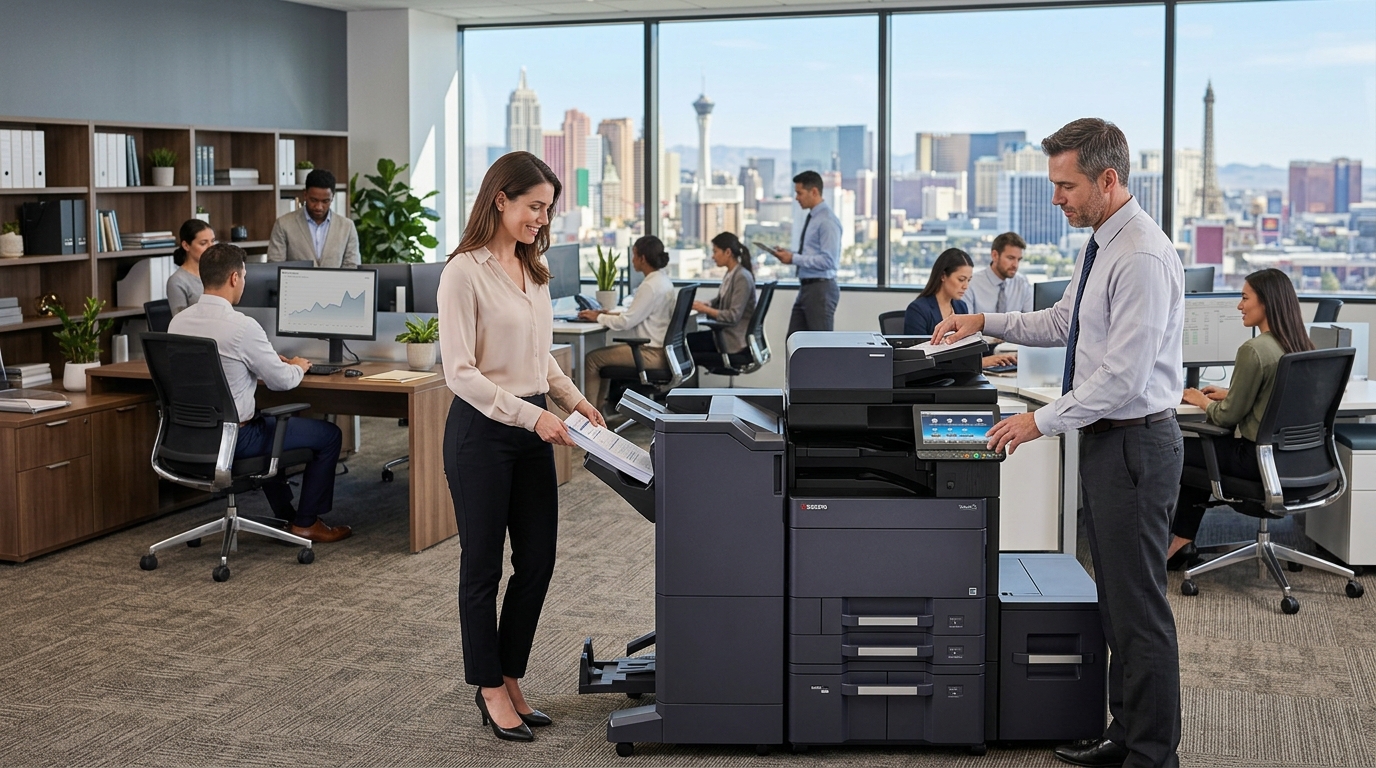
For businesses that need dependable office equipment without immediately purchasing a machine, a long term copier rental in Las Vegas can be worth considering. Long-term rentals can provide businesses with access to professional printing, copying, and scanning equipment while allowing them to structure their equipment strategy around their operational needs.
The right choice depends on the business, its expected print volume, budget, growth plans, and preferences around equipment ownership. A company with consistent document needs may approach copier rental very differently from a business that only needs a machine for a few weeks.
Understanding those differences is the first step toward making a practical decision.
What Is a Long-Term Copier Rental?
A long-term copier rental is designed for businesses that expect to need the equipment for an extended period.
Instead of purchasing the copier outright, the business rents the equipment according to agreed-upon terms.
This can be useful for organizations that want access to capable office equipment while maintaining flexibility around ownership.
For some businesses, that flexibility is important.
Technology changes. Workloads change. Companies grow. Offices move. Teams expand.
A copier that seems perfect today may not be the right fit several years from now.
Long-term rental can give businesses another way to approach those changes.
Why Consider Long-Term Rental?
There is no single reason businesses choose long-term rental.
For some, it is about budgeting. For others, it is about flexibility or avoiding the responsibility of owning equipment.
A business may also prefer to work with a copier provider that can help with equipment and service rather than managing everything independently.
The important thing is to consider the entire cost and responsibility associated with the copier.
The purchase price is only one part of the equation.
There are also supplies, maintenance, repairs, service, replacement decisions, and the time employees spend dealing with equipment issues.
Growing Businesses Have Changing Needs
One of the biggest challenges for a growing company is making decisions based on today’s needs while preparing for tomorrow.
A company may have 15 employees today and 30 employees next year.
That growth can affect printing and scanning requirements.
The office may also start producing more customer-facing documents, adding another location, or increasing administrative paperwork.
When choosing equipment, businesses should consider where they are headed rather than looking only at current usage.
Long-term rental may provide an opportunity to address present needs while leaving room to reconsider equipment as the business evolves.
Choosing the Right Capacity
One of the most important decisions is copier capacity.
A machine needs to handle your expected workload without constantly operating at the edge of its capabilities.
Start by estimating monthly print volume.
Then think about your busiest periods.
If your office typically prints 10,000 pages per month but occasionally produces 20,000 or 30,000 pages during busy periods, the equipment should be evaluated with those peaks in mind.
Print speed also matters.
If multiple employees depend on the same copier, a slow machine can create delays throughout the day.
The goal is to find an appropriate balance between capacity, functionality, and cost.
Multifunction Capabilities
Modern office copiers are often multifunction devices.
Instead of having separate machines for printing, copying, and scanning, businesses can consolidate several functions into one piece of equipment.
For many offices, that can simplify workflows.
An employee might scan a document, make copies, print a revised version, and send the digital file without moving between several devices.
When evaluating a long-term copier rental, think about which features your employees will actually use.
A machine with dozens of advanced features is not necessarily useful if your team only needs reliable printing and scanning.
On the other hand, if your business processes large quantities of documents every day, advanced features may save significant time.
Service Should Be Part of the Conversation
A copier that is not working is more than an inconvenience.
It can interrupt workflows.
Employees may be unable to print customer documents, scan paperwork, prepare meeting materials, or process administrative tasks.
For long-term equipment arrangements, service deserves careful attention.
Ask how maintenance is handled. Find out how service calls are scheduled. Understand what is included and what may be billed separately.
It is also worth knowing who your business will contact when an issue occurs.
These questions may seem small when you are signing an agreement, but they become important when the machine is part of your everyday workflow.
Renting Versus Buying
Businesses considering long-term rental often compare it with purchasing.
Both approaches have different characteristics.
Purchasing gives a business ownership of the equipment. Rental provides access to equipment without purchasing it outright.
The best fit depends on the company’s financial preferences, equipment strategy, expected usage, and long-term plans.
A business that wants to own its equipment may prefer purchasing.
Another company may place more value on flexibility and prefer a rental arrangement.
There is no universal answer because businesses operate differently.
The important thing is to compare the complete arrangement rather than focusing on a single monthly number.
Long-Term Rental Versus Leasing
Long-term rental and leasing are sometimes discussed as if they are identical, but businesses should review the actual terms of each agreement.
A copier lease generally involves a defined financing or equipment agreement over a specific term. A rental arrangement can have different structures depending on the provider and agreement.
Before signing anything, read the terms carefully.
Look at the length of the agreement, payment structure, maintenance responsibilities, equipment replacement provisions, usage terms, and what happens when the agreement ends.
The details matter.
Planning for Business Growth
A copier should not become a bottleneck as your company grows.
If your business expects to add employees, increase document volume, or open additional locations, discuss those expectations when selecting equipment.
You may need a faster machine, higher paper capacity, improved scanning capabilities, or multiple devices.
Thinking ahead can prevent the company from outgrowing its equipment too quickly.
This is especially important for businesses with predictable growth.
Las Vegas Businesses Have Different Workflows
There is no typical Las Vegas business.
A law office may produce contracts and legal documents. A property management company may process leases and tenant paperwork. A medical organization may scan administrative documents. A construction company may produce plans and project records.
Hospitality and event-related businesses can have their own unique document requirements.
Because workflows vary so much, copier selection should be based on actual usage rather than simply choosing a popular model.
Calculate More Than the Monthly Payment
When comparing long-term copier options, look beyond the monthly payment.
Consider:
- Equipment capabilities
- Expected print volume
- Color versus black-and-white usage
- Maintenance
- Supplies
- Service
- Installation
- Delivery
- Agreement length
- Upgrade options
- End-of-term requirements
A slightly different payment may make sense if the overall arrangement provides capabilities and support that better fit the business.
When Your Business Should Reevaluate Its Copier
Even after choosing a copier, it is smart to periodically evaluate whether the equipment is still meeting your needs.
Has print volume increased?
Are employees waiting for jobs to finish?
Are you scanning more documents?
Have you opened another office?
Are you using features you did not originally expect to need?
These changes may indicate that your equipment strategy needs to be reviewed.
Long-term does not have to mean “never change.”
It simply means the equipment is expected to support the business for an extended period.
Making the Decision More Practical
Choosing a copier does not need to be a technical exercise.
Start with your people.
Ask employees what they print, copy, and scan every day. Find out where they experience delays. Look at how much paper the office uses. Identify the tasks that take the most time.
Then use that information to evaluate equipment.
This approach is often more useful than starting with a list of specifications.
A Long-Term Solution Should Support Your Business
A copier is a working tool.
For businesses that rely on printed and digital documents every day, the right equipment can help keep routine processes moving.
A long term copier rental in Las Vegas may be an option for businesses that want extended access to office equipment while maintaining flexibility around ownership.
The key is to understand the agreement, evaluate your expected workload, and choose equipment that fits your business rather than simply choosing the first available machine.
Whether your company is growing, managing a stable workload, or looking for an alternative to purchasing, take the time to compare the full picture.
The right copier arrangement should make office work easier—not add another complication to it.